
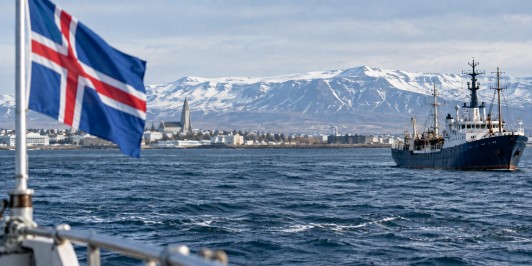
The Icelandic government is poised to propose a new law aimed at the permanent cessation of commercial whaling activities within its waters. Should this legislation pass, Iceland would join the majority of countries in banning the practice, leaving Japan and Norway as the last nations to continue commercial whaling operations. The bill is scheduled for submission to the Icelandic parliament by February, marking a significant shift following extensive discussions and increasing pressure from animal welfare advocates and conservationists who have long opposed whaling on ethical and environmental grounds.
Iceland’s current whaling industry predominantly focuses on fin whales, a species listed as vulnerable. The annual hunting season, which spans from June to September, has seen the capture of numerous fin whales under a government-sanctioned quota. This new legislative push to end whaling practices in Iceland aligns with the concerns of various animal rights groups who argue the necessity of preserving whale populations and highlight the moral implications of hunting these creatures.
The history of commercial whaling in Iceland can be traced back to its decision to resume the practice in 2006, despite a global moratorium enacted in 1986 by the International Whaling Commission (IWC) designed to protect whale populations. Norway similarly resumed whaling in 1993, while Japan made headlines in 2019 when it left the IWC to restart commercial whaling within its territorial waters and exclusive economic zone. If Iceland’s legislative efforts succeed, it would further isolate Japan and Norway in their continuation of commercial whaling practices.
Though the international ban on commercial whaling remains in effect, it does not extend to indigenous communities in certain areas, such as parts of Greenland and Alaska. These communities are permitted to hunt whales for subsistence, cultural, and traditional purposes, highlighting the nuanced approach to whaling regulations that balance conservation efforts with the needs of indigenous populations. Iceland’s potential withdrawal from commercial whaling underscores a growing global movement towards marine conservation and the ethical treatment of wildlife.