
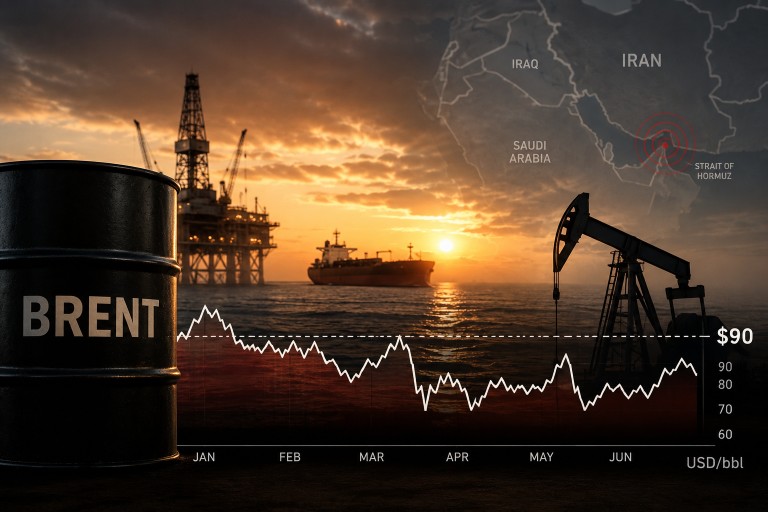
The price of Brent crude oil faces challenges in surpassing the $90-per-barrel threshold, despite a significant weekly rise, marking the largest increase since April. On Friday, the global benchmark hovered around $85, with an 11% weekly surge anticipated. In parallel, the U.S. benchmark, West Texas Intermediate, neared $80. These price hikes come in the wake of renewed military tensions between the United States and Iran, which have disrupted supply routes and reduced tanker traffic through the Strait of Hormuz, a crucial channel for about 20% of the world’s oil flow.
Despite these tensions, Brent crude has struggled to exceed this week’s peak of $87.55 per barrel. The ongoing regional conflict and the slowdown of tanker movements through the Strait have not yet propelled prices beyond this point. Market analysts suggest that the belief in potential diplomatic resolutions is tempering further price increases. Observers are keenly monitoring whether global oil inventories will start to sharply decline and if the disruption through Hormuz will continue for an extended period.
Even amid rising military tensions, oil markets have shown relative stability, with Brent crude trading within a narrow band recently. This suggests investor expectations are leaning towards a possible de-escalation rather than an escalation of the conflict. The Strait of Hormuz remains a focal point for energy markets, with tanker traffic experiencing a slowdown. Exporters are exploring alternative routes to decrease reliance on this vital waterway.
The repercussions of the situation extend beyond crude oil. In the United States, refining margins are climbing as supplies of diesel and gasoline tighten, while European fuel markets are also beginning to show signs of pressure. These strains are exacerbated by reduced fuel exports from Russia, adding another layer of stress to global energy supplies.
Market participants are closely watching two critical factors: a potential sharp decline in oil inventories and the outcome of diplomatic efforts. If these efforts falter, leading to a prolonged disruption in the Gulf, it could further impact oil prices. Until either significant inventory decreases or a breakdown in negotiations occurs, experts predict Brent crude will likely remain below $90 per barrel, despite the heightened geopolitical risks.